The Apocryphal 4th Book of Ezra
Do the Holy Scriptures contain references to the New Apostolic Church or is the reference to the fourth book of Ezra just a myth?
Introduction
Do the Holy Scriptures contain references to the New Apostolic Church or is the reference to the fourth book of Ezra just a myth? In this article, we want to clarify whether, as the New Apostolic Church has often claimed in the past, there are references to the New Apostolic Church in the 4th Book of Ezra, or whether it is a myth.
When the New Apostolic brethren visited me(a priest and his deacon), we had an intense conversation about the contradictions between the New Apostolic doctrine and biblical teaching. When they could not refute the biblical arguments, they pointed me to the 4th Book of Ezra: “It is already written in the Bible that there will be a New Apostolic Church,” they said. I am not the only one who has experienced this. Many others report similar occurrences.
Again and again, one encounters this assertion. Just a few days ago I received another e-mail asking what the Apocryphal 4th Book of Ezra and the New Apostolic Church were all about: “However, this also generated much need for discussion with individual priests in their congregation who repeatedly refer to contents of the 4th Book of Ezra in the justification of the New Apostolic Church.” Is it a myth that in Holy Scripture in the 4th Book of Ezra there is mention of a New Apostolic Church?
The Significance of the Book of Ezra for the New Apostolic Church
In fact, this book played a special role in the justification of the New Apostolic Church (NAC). How else should one understand the answer to question No. 15 in the Catechism (1) of the New Apostolic Church: “Question: What is the nature of the fourth book of Ezra? Answer: The first group, to which the fourth book of Ezra belongs, is omitted from the new editions for reasons unknown to us. The content of this book, however, is so important for our time that we can only assume it has been suppressed with a special intention in recent Bible editions.”. Also in the booklet ‘Divine Promises and their Fulfillment’ (2) in which an attempt is made to present the origin of the New Apostolic Church as part of the divine plan of salvation, the New Apostolic Church refers to this 4th book of Ezra and devotes three full pages to it (2).
Is this a Text of the Holy Scriptures?
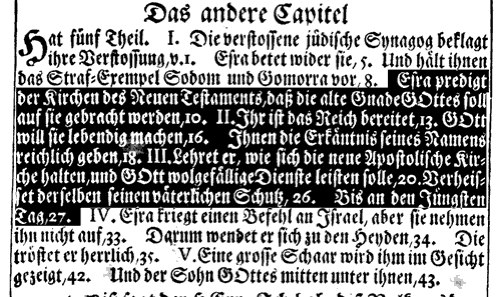
Quick clarification is brought into the apocryphal 4th book of Ezra. The 4th Book of Ezra is a so-called pseudepigraph or pseudograph, i.e. a book that bears the name of a biblical person but is demonstrably not written by that person. For this reason and its questionable content, it is not part of the canon of Holy Scripture but is only added to some editions of the Bible as an apocryphal book. Moreover, only the table of contents of the 2nd chapter of the 4th book of Ezra speaks of a “new apostolic church”. This table of contents does not belong to the text of the book itself but was prefixed to the 2nd chapter as a commentary by an editor in the Middle Ages.
Antics and Fables
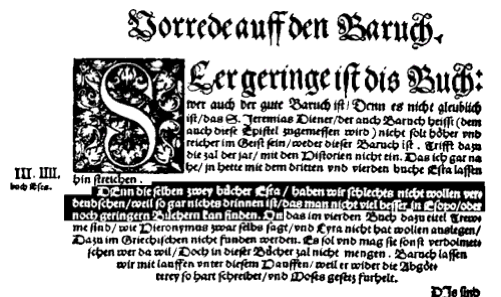
Furthermore, Luther says of the third and fourth books of Ezra: “Tertium Esdrae (3rd Ezra) I throw into the Elbe. quarto sunt somnia Esdrae (4th Ezra), which are beautiful, and are also otherwise good böslin (Pösslein, antics) inside”. (6) So Martin Luther thinks that there are nice antics in the 4th book of Ezra!
The 4th book of Ezra was never in the Holy Scriptures!
First “In the second half of the 17th century, the fourth book of Ezra was included in the Luther Bibles printed in Nuremberg by ‘Endter’. Likewise in 1748 in the ‘Carriere Bible’ from Lörrach. From the 19th century, one removed this addition to the Luther Bible again - thus the Luther Bible was again without a fourth book Ezra, as Luther wanted it himself. So the fourth book Ezra was not removed from the real Luther Bible - it was never in it at all - because LUTHER wanted it that way!” (7) wrote Siegfried Bühler a renowned expert in the field of ancient and medieval writings on the subject.
When this controversial book of Ezra was added to the Luther Bible in the 17th century, it was done with the remark: “That we nevertheless want to append the above-mentioned books, as it were, to the abundance, nothing else than the inquisitiveness of some people causes us to do so. I do not know what secrets and prophecies they seek in these writings, especially in the fourth book of Ezra, and want to spread among the people in the German language … it remains, however, that these books are’apocryphal’ (added later), their contents uncertain, partly drawn together from other, credible ones, without their statements being as certain as the other books”. (8)
Summary
In summary, we can say that a “new apostolic church” is only mentioned in the table of contents of the 2nd chapter of the 4th book of Ezra, which was written by a commentator or editor. The 4th book of Ezra itself, and even more so its contents, cannot be called a biblical text, that is, belonging to the Holy Scriptures. The fourth book of Ezra was not suppressed, as claimed by the New Apostolic Church, because in reality it never belonged to the Holy Scriptures. To claim that there is already a reference to the New Apostolic Church in the Bible is therefore untenable and inadmissible.
On Shaky Ground
One must seriously ask why the New Apostolic Church places its legitimacy on such shaky ground and, with regard to the content, says: “The content of this book, however, is so important for our time” (1)! Even Luther, who according to the New Apostolic view became New Apostolic in the hereafter (9) and whose Bible translation is used, considers this book comparable to the fables of Aesopus (4) and even less meaningful than these. The New Apostolic Church thus relies on a myth in relation to the fourth book of Ezra.
Fortunately, Chief Apostle Richard Fehr has probably also recognized that this text has been overrated in the past. He answered the question in an interview with the youth, “What is the significance of the reference to the 4th book of Ezra for the New Apostolic Church?” Answer: “It can be considered merely one reference among many to the work of God of the present time” (10) He does try to put things into perspective here, but unfortunately, this answer again makes two things clear. Firstly, he actually still sees a reference to the New Apostolic Church in the text, and secondly, he once again expresses the exclusive claim of the New Apostolic Church: “the work of God of the present day“.
© Project B
Sources/Notes
1) Fragen und Antworten über den Neuapostolischen Glauben, Frage Nr. 15, Verlag Friedrich Bischoff GmbH, 1981, Frankfurt am Main
2) Göttliche Verheißungen und ihre Erfüllungen Seite 26-28, Neuapostolische Kirche - Internationaler Apostelbund, 1983, Zürich
3) Inhaltsangabe zum 2. Kapitel des 4. Buches Esra aus einer Bibelausgabe des 17. Jahrhunderts, zitiert über: Rund um das vierte Buch Esra und die “neue Apostolische Kirche” Version 4.2, Siegfried Bühler, 1998
4) Esopo = Aesopus, Aesopus war ein griechischer Sklave, er lebte im 6. Jahrhundert vor Christus und verfasste Tierfabeln. Luther verdeutschte einige dieser Fabeln, denn das aus der Antike überliefert Fabelgut war in den mittelalterlichen Klosterschulen ein beliebter Lesestoff
5) Vorwort zu Baruch, Luther-Bibel von 1545, zitiert über Siegfried Bühler siehe 3)
6) D. Martin Luthers Werke, Tischreden 1. Band, Seite 337, Nr. 692, 1912, Weimar
- Siegfried Bühler siehe 3)
- Vorrede zum dritten und vierten Buch Esra und des dritten Buchs der Makkabäer, zitiert über Göttliche Verheißungen und ihre Erfüllungen, Seite 26, Neuapostolische Kirche - Internationaler Apostelbund, 1983, Zürich
- Apostel F.W. Schwarz schreibt am 10. April 1874 in der periodischen Schrift &Mac226;De Herinnering’ folgendes über die Taufe Luthers: „…Und denkt euch nur, am Ende des Gottesdienstes kam eine Weissagung (doch ich habe sie noch nicht empfangen): >>Ich, der Herr…gedenke heute an meinen Knecht Martin LUTHER, damit er zu meiner Braut gehöre. Mein Knecht VERKRUISEN, gehe zu meinem Knecht, dem Apostel, und lasse dich taufen für meinen Knecht Martin LUTHER.<< Mithin gehört Vater LUTHER fortan zu den Erstlingen und wohl zum Stamme Juda!“ und dann weiter am 16. April über die Versiegelung Luthers: „…Dann kann ich euch folgendes Gesicht mitteilen: >>Bei der Versiegelung von Martin LUTHER umgab den Apostel SCHWARTZ und Bruder VERKRUISEN ein Glanz von Licht<<…“! Zitiert über ’Das Entschlafenenwesen - Eine Darstellung des Glaubens und Handelns im Werke des Herrn…’, S. 70-71, Günter Knobloch, 1984
- Interview der Jugend aus Süddeutschland, die schriftliche Fragen dem Stammapostel vorlegte,
http://geocities.com/stiegelmeyr/Stap_Jugendinterview.htm, 2004